


HEALTHCARE IT
End-to-end IT solutions for healthcare organizations.

Complex solutions designed to transform your business.

Optimize your entire marketing and sales ecosystem.

Accelerate business performance with data-driven decisions and a connected CRM and ERP solution.

Tailored marketing strategies paired with deep technology expertise.
RESOURCES
FREE DOWNLOADS

MIPS quality measures are the standardized clinical performance measures that eligible clinicians report to CMS under the Merit-based Incentive Payment System (MIPS). The quality performance category is scored on the measures a clinician or group selects and reports, plus certain measures CMS calculates from claims. It is one of the two most heavily weighted categories in the MIPS final score, which determines a positive, neutral, or negative Medicare payment adjustment two years later.
This guide covers how the quality category works, the current reporting requirements, collection types, how to select measures, where CMS is taking the program, and why quality performance usually starts in the EHR.
Key Takeaways
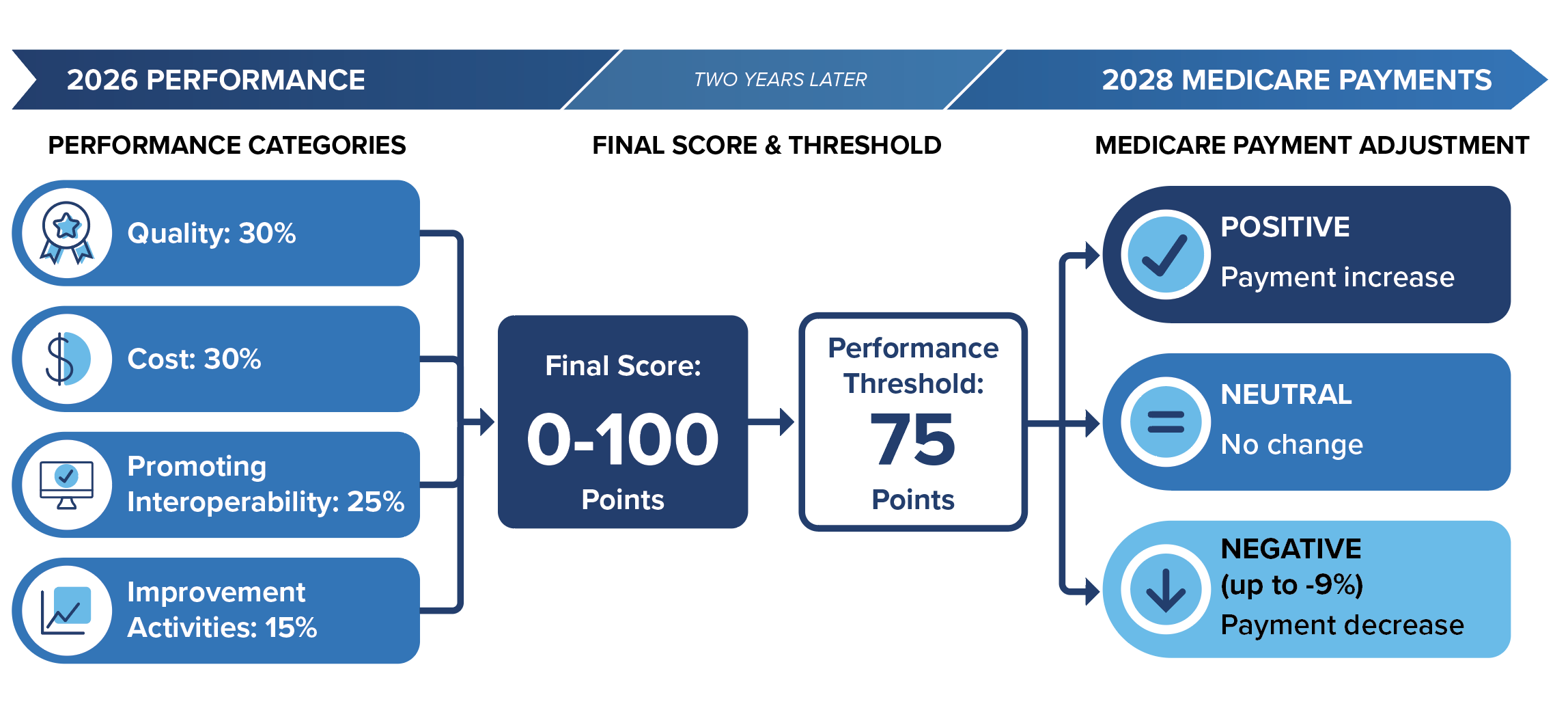
MIPS scores clinicians across four performance categories: quality, cost, Promoting Interoperability, and improvement activities. For the 2026 performance period, CMS weights quality and cost at 30% each, Promoting Interoperability at 25%, and improvement activities at 15%. Those weights shift when a category is reweighted, which is common for small practices that qualify for Promoting Interoperability reweighting.
The weighted category scores add up to a final score between 0 and 100. That score is compared with the performance threshold, which CMS has finalized at 75 points through the 2028 performance period.
Inside the quality category, each measure earns achievement points based on where performance falls among the benchmark deciles for its collection type, generally up to 10 points per measure. The category can also earn up to 10 additional percentage points for improvement over the prior year, which rewards practices that raise performance even if they are not yet in the top deciles.
The financial effect lands two years later. A 2026 final score sets the 2028 Medicare payment adjustment, which can reach a 9% reduction for the lowest scores. Positive adjustments are scaled to keep the program budget neutral, so the upside is usually smaller than the downside. For a revenue cycle leader, that asymmetry is the point: MIPS is primarily a penalty to avoid, and quality is the category a practice can influence most directly.
The requirements below apply to the 2026 performance period. CMS updates them every year through the Physician Fee Schedule, so confirm the current year on qpp.cms.gov before selecting measures.
The measure inventory changes too. For 2026, CMS added 5 quality measures, removed 10, and made substantive changes to 30, and finalized six new MIPS Value Pathways. A measure set that scored well last year may not score the same way this year even if clinical performance is unchanged.
Each quality measure is specified for one or more collection types, and the collection type determines the measure logic, the data source, and how the measure is benchmarked.
The same clinical measure can score differently depending on the collection type, because each has its own benchmark. Choosing a submission pathway is its own decision, which we cover in our guide to MIPS registry reporting.
The tradeoff usually comes down to data. eCQMs depend entirely on structured EHR data and can be submitted directly from certified technology. Registry-based MIPS CQMs allow more flexibility in how data is abstracted, but add a vendor and a data feed to manage. Practices on a single well-configured EHR often favor eCQMs, while multi-EHR groups often favor a registry that can aggregate across systems.
Most practices pick measures by scanning the inventory for ones that sound relevant. A more reliable approach works through five questions in order.
Do you have the patients? A measure needs enough denominator-eligible patients to meet the case minimum. Pull your own population data before you commit.
Where does your performance sit against the benchmark? Each measure has decile benchmarks by collection type. A measure where you already perform in the top deciles earns more points than one where you are average.
Is the measure topped out? Topped-out measures are generally scored on a reduced scale, which caps the points available. Check status for the current year.
Does your EHR capture the numerator today? If the care is delivered but documented in free text, it will not count. This question eliminates more measures than any other.
Can you improve it within the year? Favor measures where a workflow or documentation change can move performance before December 31.
Your own history is the best starting data. The prior year's performance feedback in the QPP portal shows how each measure scored, where points were lost to data completeness or case minimums, and which measures sat near the top of the benchmark range.
Specialty practices face the same questions with a narrower inventory. Our guide to MIPS measures for primary care walks through them for family and internal medicine.
The same handful of errors show up year after year, and most have nothing to do with clinical care.
Choosing measures without checking the denominator. A measure with too few eligible patients earns nothing, however well the practice performs.
Missing data completeness through partial-year capture. A workflow fixed in June still leaves five months of uncaptured cases, which can drop a measure below the 75% requirement.
Ignoring annual specification changes. Measure titles, logic, and codes change. Diabetes measure Quality ID 001, for example, now reads as a glycemic status assessment rather than an HbA1c measure. Templates built for last year's specification can quietly stop counting.
Waiting for the registry at year end. By the time submission data surfaces a gap, the performance period is over. Quarterly reviews catch problems while there is still time to fix them.
|
|
Traditional MIPS |
MIPS Value Pathways |
APM Performance Pathway |
|
Who it is for |
Any MIPS eligible clinician |
Clinicians whose specialty or condition has an MVP |
Participants in MIPS APMs, including ACOs |
|
Quality measures |
Six, from the full inventory |
Four, from the MVP measure set |
Fixed APP measure set |
|
Population health |
Claims-based measures calculated by CMS |
Population health measure calculated by CMS |
Included in the APP set |
|
Registration |
Not required |
Required during the CMS window |
Through the APM |
MIPS Value Pathways group quality measures, improvement activities, and cost measures around a specialty or condition. CMS has been moving toward them for several years, and the direction is now explicit.
The CY 2027 Physician Fee Schedule proposed rule, released in July 2026, proposes three changes that matter for quality reporting:
The proposed MIPS core measure requirement would take the place of the current outcome measure requirement, so every reporting clinician would share at least one common measure regardless of pathway. For practices, that means one measure choice may soon be made for them, which makes documentation capture for that measure a priority once the list is final.
These are proposals, not final policy. CMS is expected to publish the final rule in late 2026. The practical step now is the same either way: identify the MVP that fits each specialty in your organization and test your current performance against its measure set.
Registries and billing vendors tend to treat measure selection as a catalog exercise. In practice, most quality scores are decided upstream, by how the EHR captures the care that was delivered.
The most common failure is simple. The clinician performed the screening, controlled the blood pressure, or documented the follow-up plan, but recorded it in a note rather than the structured field the measure logic reads. The care happened. The measure says it did not.
Three EHR factors drive most of the gap: whether numerator data is captured in structured fields at the point of care, whether the measure logic in the EHR or registry matches the current year's specifications, and whether anyone reviews performance during the year rather than at submission. Each is a configuration and workflow question, which is why quality performance improves fastest as part of broader EHR optimization.
Ownership matters as much as configuration. Name one person accountable for each measure, give them access to performance data during the year, and review results quarterly with the clinical and revenue cycle leaders who can act on them.
“When a practice tells us its MIPS quality score is low, our first question isn’t about the care. It’s about where the care gets documented. Time and again, the clinicians are doing exactly what the measure asks for, but it’s recorded in free text the measure logic can’t read. Fix the workflow and the structured fields, and the score often catches up to the care that was there all along.” Chad Anguilm, VP of Healthcare Delivery & Operations
MIPS quality measures reward practices that choose measures deliberately and capture care cleanly, and the move to MVPs will reward that discipline even more. Provisions Group helps practices select measures, fix the documentation and EHR configuration behind them, and prepare for the transition. Explore our MIPS consulting services, or read our guide to MIPS registry reporting to choose the right submission pathway.
Ready to review your measure set? Schedule a consultation with our team.


