


HEALTHCARE IT
End-to-end IT solutions for healthcare organizations.

Complex solutions designed to transform your business.

Optimize your entire marketing and sales ecosystem.

Accelerate business performance with data-driven decisions and a connected CRM and ERP solution.

Tailored marketing strategies paired with deep technology expertise.
RESOURCES
FREE DOWNLOADS

An EMR conversion is the process of moving patient records and clinical data from one electronic medical record system to another, including the mapping, validation, and archiving decisions that go with it. The term still gets used for the original move from paper charts to a digital system, but with EHR adoption effectively universal across US hospitals and physician practices, almost every conversion project today is a system-to-system replacement.
That shift changes the nature of the problem. Going from paper to digital was a documentation project. Going from one EHR to another is a data project, and the decisions that determine whether it succeeds are made months before anyone touches the new system.
Key Takeaways
A conversion breaks into five phases, and organizations consistently underweight the first and last.
Discovery and scoping. What data exists, where it lives, what condition it is in, and what regulatory retention obligations attach to it. This is also where you inventory the interfaces and downstream reports that consume data from the outgoing system, which is the step most often skipped.
Data mapping. Reconciling how the source and target systems represent the same clinical concepts. Problem lists, medication formularies, allergy structures, and result codes rarely align cleanly, and every mismatch is a decision someone has to make and document.
Build and configuration. Order sets, documentation templates, clinical decision support, user roles, and interfaces in the new system. A conversion is a configuration project wearing a data project's clothes, and the configuration decisions outlive the migration.
Testing and validation. Iterative loads with clinical review at each pass, not a single migration event with a check afterward.
Go-live and stabilization. The first ninety days, when data issues surface in real use. Reserve capacity for this rather than releasing the team at go-live.
The instinct is to bring everything. It is the wrong instinct, and resisting it is the single highest-leverage decision in the project.
Full historical conversion multiplies mapping work, extends the timeline, raises cost, and introduces data of uncertain quality into a system clinicians are meant to trust from day one. It also imports the source system's accumulated errors.
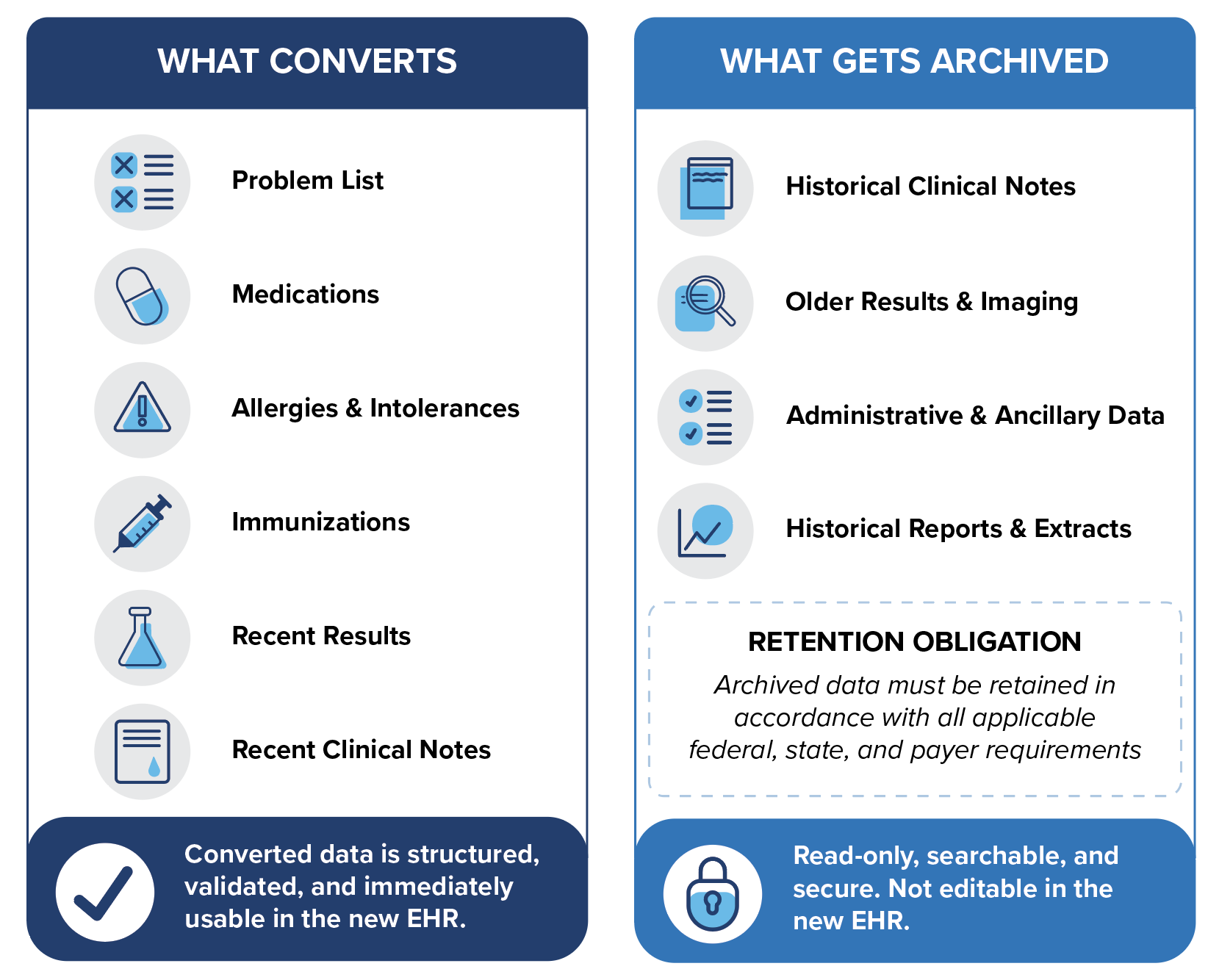
The pattern that works: convert a defined set of discrete data, then archive the rest. Problems, medications, allergies, immunizations, and a bounded window of recent results and notes typically convert. Everything else moves to a read-only legacy repository that meets retention requirements and remains searchable.
This requires two things most projects underspecify. Clinical leadership has to agree on the conversion window, because the answer is different for pediatrics than for an urgent care network. And someone has to own the legacy repository decision: how long it stays available, who can access it, what it costs annually, and what happens when the vendor contract ends.
"One of the most valuable conversations we facilitate is helping organizations determine the right conversion window. Clinical leaders often start with the assumption that every historical data element must move into the new EMR, but that approach almost always increases cost, complexity, and risk without delivering equivalent value. We work with stakeholders to identify the data clinicians need for day-to-day patient care, define appropriate lookback periods based on specialty and workflow, and establish a sustainable archival strategy for everything else. The organizations that make these decisions early typically experience faster implementations, cleaner data, and greater provider confidence at go-live."
– Chad Anguilm, VP, Healthcare Delivery & Operations, Provisions Group
Mapping treated as a technical task
Deciding that a problem coded one way in the source system becomes a different code in the target is a clinical decision with downstream consequences for quality reporting and risk adjustment. When mapping is delegated entirely to a technical team, those decisions get made on structural logic rather than clinical meaning, and the effects surface months later in reporting.
Testing performed by testers
A migrated record can pass every technical validation and still be unusable. Field-level completeness does not tell you whether a physician opening that chart can reconstruct the patient's history. Clinical validation by the specialties who will use the records is not optional, and it takes longer than technical testing.
Downstream systems discovered late
Registries, quality reporting, billing, analytics, and any interface that reads from the outgoing system. These break silently and are found weeks after go-live, often by a payer or a regulator. Inventory them during discovery. Our guide to EHR integration strategy covers how to map those dependencies before they surface.
Legacy access left unresolved
The old system stays running because nobody decided when it could be turned off, and the organization pays maintenance on it for years. Decide the decommissioning date and the archive strategy during scoping, not after go-live.
Training scheduled after the build
By then the configuration decisions that would have made adoption easier are already locked. Clinical input belongs in build, not in training.
Six things to get right, refined from what consistently separates the conversions that land from the ones that struggle.
A conversion is not the end of the work. It resets the baseline. The configuration decisions made during the build determine how much EHR optimization the organization needs in the following two years, and the interface decisions determine how much integration work follows. Organizations that treat the conversion as a delivery milestone tend to rediscover both a year later.
If the underlying question is whether your systems can exchange data at all rather than how to move it once, that is a different problem, covered in integration vs interoperability.
The decisions that determine whether a conversion succeeds are made in scoping, months before the first data load. Getting the conversion window, the archive strategy, and the downstream inventory right at that stage costs a fraction of fixing them after go-live.
Provisions Group supports healthcare organizations through EMR conversions and EHR migrations, from scoping and data mapping through go-live and stabilization. Explore our EHR integration services or schedule a consultation to talk through your timeline.


