


HEALTHCARE IT
End-to-end IT solutions for healthcare organizations.

Complex solutions designed to transform your business.

Optimize your entire marketing and sales ecosystem.

Accelerate business performance with data-driven decisions and a connected CRM and ERP solution.

Tailored marketing strategies paired with deep technology expertise.
RESOURCES
FREE DOWNLOADS

Integration and interoperability are used interchangeably in healthcare IT conversations, but they describe two different things. Integration is the technical work of connecting systems so data can move between them. Interoperability is the ability of those systems to exchange data in a way that both sides can interpret and use without manual translation. Integration builds the pipes. Interoperability ensures what flows through them is understood. Healthcare organizations need both, and confusing the two leads to projects that connect systems without actually solving the data problem.
This article defines both terms clearly, explains why the distinction matters for IT strategy, walks through the standards that enable interoperability, and addresses what the difference means when evaluating a consulting or integration partner.
Integration is the technical work of connecting healthcare systems so data can move between them. Interoperability is the ability of those systems to exchange data that is understood and usable on both ends without manual translation. Integration builds the connection. Interoperability ensures the data exchanged is meaningful. Healthcare organizations need both.
Integration is the technical process of connecting two or more healthcare systems so data can flow between them. It is engineering work: building interfaces, configuring APIs, setting up middleware, and mapping data fields from one system to another.
Common integration types include EHR to billing/PM, EHR to lab information system (LIS), EHR to imaging (PACS), EHR to patient portal, and EHR to CRM. Each requires a purpose-built interface or API connection.
How integrations are built: HL7 v2 messaging (the workhorse of healthcare data exchange for decades), RESTful APIs, direct database connections, and middleware/interface engines (Rhapsody, Mirth Connect, Cloverleaf) that sit between systems and translate data formats.
The limitation: integration gets data from point A to point B, but it does not guarantee the receiving system can interpret the data correctly. A lab result that arrives but can't be matched to the right patient record, or a medication list in a format the receiving EHR can't parse, is an integration that works technically but fails operationally.
Interoperability is the ability of different healthcare IT systems to exchange data and use that data meaningfully without requiring custom translation on either end. The ONC defines it as the ability to exchange electronic health information and use it without special effort on the part of the user.
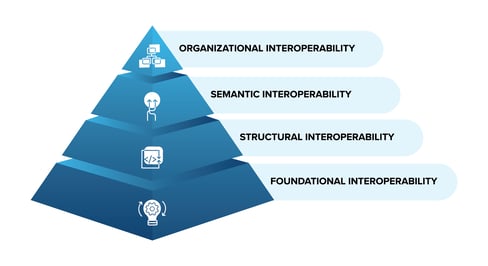
The HIMSS interoperability framework defines four levels:
Most healthcare organizations have achieved foundational and structural interoperability. The hard part is semantic: ensuring that when System A sends a diagnosis code, System B interprets it the same way and makes it usable for care decisions.
The standards that enable interoperability: HL7 FHIR, USCDI (United States Core Data for Interoperability), and CCDA (Consolidated Clinical Document Architecture). The 21st Century Cures Act and ONC interoperability rules are the regulatory drivers.
Integration without interoperability. Your systems are connected, but data quality problems persist. Lab results arrive but aren't matched to patient charts. Medication lists come across in formats requiring manual cleanup. Billing interfaces move charges but drop modifiers. This is the most common state in healthcare IT: systems are integrated, but data is not truly interoperable.
What this means for your IT strategy. When scoping an integration project, don't stop at "can the data get there?" Ask: "Can the receiving system use the data without manual intervention?" If the answer is no, you have an interoperability gap. This distinction affects vendor selection, project scope, timeline, and cost.
The governance dimension. Organizational interoperability requires governance: who owns the data definitions, who approves changes to interfaces, and what happens when a system update breaks an existing integration. Most organizations skip this level. It is the reason integrations that worked at go-live break six months later.
If you're scoping an integration project: Ask your partner whether they're solving for connectivity or for interoperability. A partner who builds HL7 interfaces without addressing data mapping, vocabulary alignment, and governance is solving half the problem.
If you're evaluating an EHR migration: Integration and interoperability challenges are the most underestimated line items in any migration. Data mapping, interface rebuilds, and semantic consistency across old and new systems require dedicated expertise.
If you're dealing with data quality problems across systems: The root cause is almost always an interoperability gap, not an integration failure. The data is getting there. It's just not usable when it arrives.
Whether your organization is planning a new integration, troubleshooting existing interfaces, or preparing for a system migration, the distinction between integration and interoperability determines how you scope the project and who you choose to execute it. Learn more about our EHR integration services.
What matters is how your organization applies it: scoping integration projects correctly, choosing partners who understand both layers, and building governance that prevents interoperability gaps from accumulating.
Explore our EHR integration services.


