


HEALTHCARE IT
End-to-end IT solutions for healthcare organizations.

Complex solutions designed to transform your business.

Optimize your entire marketing and sales ecosystem.

Accelerate business performance with data-driven decisions and a connected CRM and ERP solution.

Tailored marketing strategies paired with deep technology expertise.
RESOURCES
FREE DOWNLOADS

Healthcare interoperability solutions are the standards, platforms, and services that let different health IT systems exchange data and, just as important, use that data consistently once it arrives. The word gets used loosely, often as a synonym for any kind of data sharing. In practice, real interoperability spans four distinct levels, and the gap between the easy ones and the hard ones is where most organizations get stuck.
If your systems can technically send data to each other but your team still cannot trust a shared medication list or a referral record, you are experiencing the difference between connectivity and interoperability firsthand. This guide breaks down what healthcare interoperability solutions deliver, the standards and frameworks underneath them, where they tend to break down, and how to move from buying a capability to realizing an outcome.
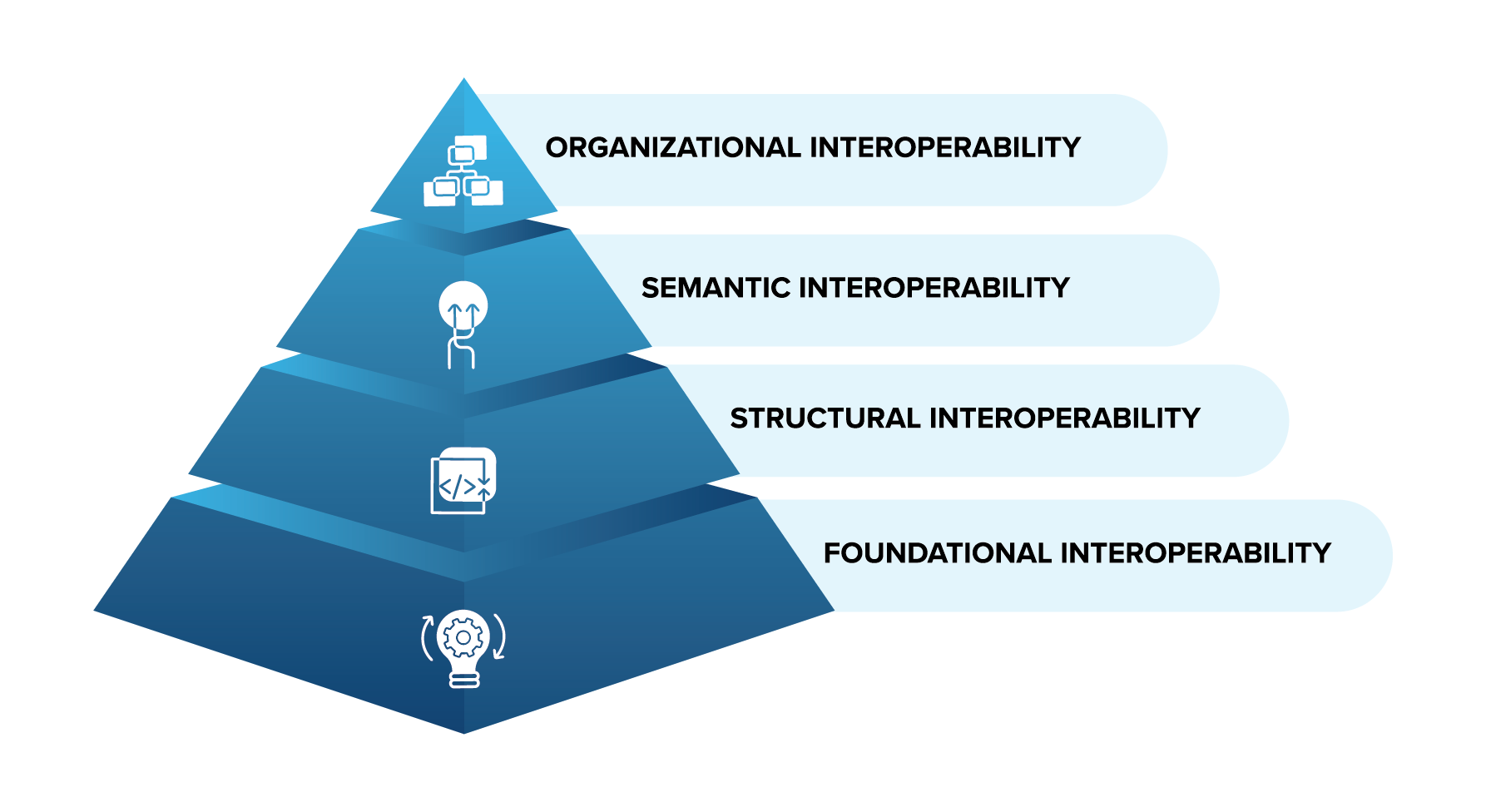
The Healthcare Information and Management Systems Society defines interoperability across four levels, and the framing is genuinely useful for diagnosing where an organization is stuck. Foundational interoperability means one system can send data and another can receive it. Structural interoperability defines the format and syntax, so the receiving system can parse the message into discrete fields. Semantic interoperability means both systems interpret those fields the same way, so a value labeled the same in two systems carries the same meaning in both. Organizational interoperability covers the governance, policy, and trust agreements that allow exchange to happen across organizational boundaries at scale.
Most vendor conversations focus on the first two levels because they are the most tractable to sell and demonstrate. The harder, more valuable work lives in the upper two. A lab result can arrive perfectly formatted and still be useless if the receiving system maps it to the wrong code, or if no governance agreement permits the two organizations to act on it. Understanding which level you are failing at is the difference between buying the right solution and buying an expensive connection to the same problem. It is also why we treat the difference between integration and interoperability as foundational reading: integration gets you through the first two levels, but interoperability is only real once the top two hold.
A handful of standards and federal frameworks now define how interoperability works in US healthcare. Knowing what each one does makes vendor claims much easier to evaluate.
For a buyer, the practical takeaway is that these standards are not interchangeable. HL7 v2 and FHIR solve different problems and usually coexist for years. USCDI defines what data can travel. TEFCA governs who is allowed to exchange with whom. A vendor who treats interoperability as a single feature, rather than a stack of standards each doing a specific job, is a vendor to question, because the gaps in your environment almost never sit where a one-size-fits-all pitch assumes they do.
The momentum is real. HHS reported that nearly 500 million health records had been exchanged through TEFCA by early 2026, up from roughly 10 million a year earlier, and Epic estimated that before TEFCA roughly 30 percent of US hospitals could not exchange electronic health information at all. The national floor is rising quickly. What it does not do is configure your environment for you.
When an interoperability initiative disappoints, the failure almost always sits at the semantic or organizational level rather than the technical one. The connection works; the value does not materialize.
We often find that interoperability projects fail at the semantic and governance layers, not the technical one. In a recent client engagement, systems were exchanging data successfully, yet leaders could not trust the reports being generated because key data elements were defined and mapped differently across applications. By establishing data governance, assigning ownership, and standardizing mappings, PG helped turn a technically connected environment into a trusted source of operational insight. The technology remained largely unchanged, the confidence in the data changed dramatically.
- Chad Anguilm, VP of Healthcare Delivery & Operations
The reason interoperability is worth the effort is not compliance or connectivity for its own sake. It is the moment a clinician opens a chart and trusts the outside records in it without picking up the phone. It is a care transition where the receiving team already has the medication list, the recent labs, and the active problems. It is leadership reporting that reconciles because it draws from a coherent data environment rather than a patchwork of exports.
Getting there is a configuration and governance exercise, not a purchase. The organizations that benefit most from the rising national floor are the ones that have done the unglamorous internal work: clean identifiers, agreed code mappings, clear data ownership, and an architecture designed to participate in networks like TEFCA rather than bolt onto them. A capable partner helps you sequence that work against clinical and financial priorities instead of trying to boil the ocean.
Consider a patient who arrives at an emergency department while traveling. With genuine interoperability in place, the care team pulls the current medication list, recent labs, and active conditions from the patient's home system in seconds, and treats accordingly. Without it, the same team works blind or waits on a fax, and the patient repeats a history they may not fully remember. That gap, multiplied across every transition of care an organization touches, is the concrete thing interoperability solutions exist to close, and it is why the upper two levels matter far more than any single connection.
If interoperability is on your roadmap, our EHR integration services team can assess where your environment sits across the four levels and design solutions that produce trusted data, not just connected systems. For the underlying system-to-system work, start with our guide to healthcare data integration.
The national infrastructure for connected care is arriving faster than most internal environments are ready to use it. Closing that gap is specific, sequenced work, and it starts with knowing which of the four levels is holding you back.


