


HEALTHCARE IT
End-to-end IT solutions for healthcare organizations.

Complex solutions designed to transform your business.

Optimize your entire marketing and sales ecosystem.

Accelerate business performance with data-driven decisions and a connected CRM and ERP solution.

Tailored marketing strategies paired with deep technology expertise.
RESOURCES
FREE DOWNLOADS

EHR configuration governance is the set of policies, roles, and decision-making processes that control how an electronic health record system is changed over time: who can request modifications, who approves them, and how changes are prioritized, documented, and reviewed. When that governance is missing, configuration decisions get made one at a time with no oversight, accumulate without anyone tracking them, and slowly turn a well-implemented EHR into one that no single person fully understands.
Most leaders do not notice governance until it is already broken. The system was configured well at go-live, the build worked, and then eighteen months of small changes later, nobody can explain why a workflow behaves the way it does. This guide covers why governance gets ignored, how configuration sprawls without change control, the signs the problem is organizational rather than technical, how to build a model that holds, and the opposite trap of governing so tightly that nothing gets done.
Configuration governance is easy to confuse with two adjacent things. It is not configuration management, which is the hands-on work of building and maintaining order sets, templates, and rules. And it is not optimization, which is the outcome of a better-performing system. Governance sits above both: it is the decision-making layer that determines which changes happen, who signs off, and how the organization keeps a record of it all.
Governance gets skipped for an understandable reason. At go-live, every ounce of attention goes to launching the system, training clinicians, and surviving the first weeks. Almost no one is thinking about the operating model for changes that will arrive for years afterward. So the committee never forms, the intake process never gets defined, and change simply happens through whoever has access and a reason to act.
The cost shows up later. Every modification becomes a local decision made in isolation. Six months on, the organization cannot answer basic questions: who approved this build, why did this template change, which alerts were added and by whom. The EHR did not get worse because the software failed. It got harder to manage because no one was governing how it changed.
The mechanism behind configuration sprawl is a simple supply-and-demand mismatch. Researchers studying governance at academic medical centers found that requests for EHR customization routinely exceed the clinical informaticist and analyst time available to fulfill them, creating bottlenecks at intake where the people making requests have deep clinical expertise but limited informatics context. When demand outruns capacity and there is no system for sorting it, the result is predictable.
None of this requires anyone to act carelessly. It is the natural outcome of a system with high demand for change and no agreed way to govern it.
Before deciding the EHR itself is the issue, it is worth checking whether the real problem is how change is governed. A few signs are telling.
If these sound familiar, the fix is not a new system. It is an operating model for the one you have.
A governance model does not need to be elaborate to work. It needs to be clear, owned, and used in practice. Five components carry most of the value.
Effective EHR governance is not about creating more meetings; it is about creating a repeatable decision-making process. Before governance, requests often arrive through multiple channels, priorities change frequently, and ownership is unclear. By implementing a governance committee, single intake process, and structured triage model, PG helps organizations move from reactive request management to strategic prioritization. The result is greater transparency, stronger stakeholder alignment, and confidence that every change supports both clinical and financial objectives.
- Chad Anguilm, VP of Healthcare Delivery & Operations
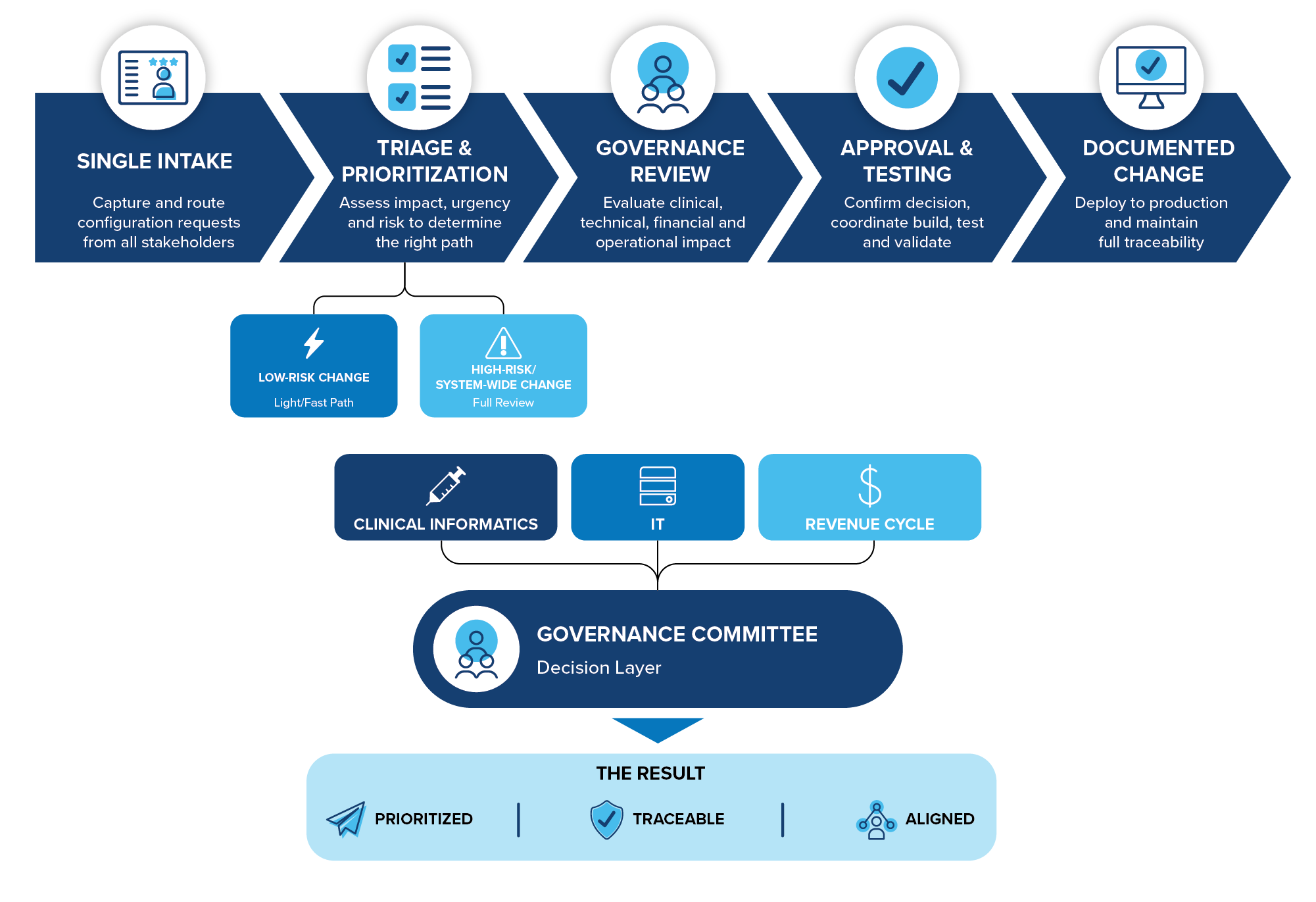
Governance can fail in the other direction too. Push the controls too far and the cure becomes the disease. Researchers examining EHR standardization and governance have warned that overly rigid change control can create veto points that make needed changes slow to occur and burdensome to pursue. When a routine template tweak has to clear the same gauntlet as a system-wide policy change, clinicians stop asking and start working around the system, which is exactly the behavior governance was meant to prevent.
The answer is to right-size governance to the risk of the change. Low-risk, reversible adjustments should move quickly through a light path. High-risk, system-wide changes get the full review. A governance model that treats every change as equally dangerous is not safer. It is just slower, and slow governance erodes itself.
Standing up governance is different from building configuration, and not every consultant does both. The right partner can implement the order sets and templates, and also install the operating model that keeps those builds from decaying. A few questions separate the two:
Provisions Group helps healthcare organizations build governance that makes configuration an asset again rather than a liability. If change has gotten away from your team, our EHR consulting services can help you put an operating model in place. Governance is one pillar of a broader EHR optimization program, and it works hand in hand with clinician adoption.
Configuration sprawl is not a sign of a bad system or a careless team. It is what happens when a high-demand environment has no agreed way to govern change. The fix is a clear, shared, right-sized operating model, and it starts with seeing how change flows through your organization today.


